What is "Do It"?
"Do It" is a happy coincidence. Phonetically, it matches how my last name, De Wit, is often pronounced in English. But beyond that, these two words capture the core of a philosophy I've developed over time. Do It is my approach to personal effectiveness: a practical method I use in how I live, work, and create. This essay explains the three core meanings of Do It and why they are so effective when combined:
1. Do it — Choosing to Act (Agency through Existentialism)
The first association that probably comes to mind when you hear Do It is something like the Nike slogan. A call to action that urges you to stop hesitating, stop making excuses, and just get going. Don't overthink. Don't blame your circumstances. Don't wallow in self-pity. Do It.
That spirit absolutely lives within what I mean by Do It, but with an important caveat.
It should never be about acting in spite of your desires. It's not about forcing yourself through pain or doing something for the wrong reasons. Do It is not a demand for discipline at all costs. It's about choosing to act. Not because someone else told you to. Not out of guilt, pressure, or obligation. But because you want to. Because you have a desire and you have the power to move.
This is a fundamental truth: agency is built into all of us. We have the capacity to make choices. To act intentionally. And I believe deeply that we should regularly remind ourselves of this fact—and use it to guide how we live.
This idea echoes existentialist philosophy, which emphasizes that humans are radically free, and we can use that freedom to escape the inherent meaningless of the world. If this resonates, I highly recommend two works that powerfully articulate it: Jean-Paul Sartre's Existentialism Is a Humanism, and one of my favorite books—Viktor Frankl's Man's Search for Meaning
2. Do it — Solve Problems That Matter (Direction through Critical Rationalism)
Agency is powerful. We can just do things. But what should we do? Where can we have meaningful impact?
Stephen Hawking once voiced a bleak, but common, view: that our actions are ultimately insignificant. He described humanity as "chemical scum on a moderate-sized planet," emphasizing our irrelevance in the universe.
But he couldn't be more wrong.
Humans are the most significant force in the cosmos. The coldest temperature ever achieved wasn't out in deep space. It was created here, on Earth, in a lab at MIT. We've synthesized entirely new elements that don't exist naturally in the universe by smashing atoms together in particle accelerators. We've turned rocks and fire into spacecraft that have left the solar system. Voyager 1, a human-made object, is now more than 15 billion miles away, still whispering data back to us. All of this is possible because of our ability to create new knowledge.
As David Deutsch explains, the extraordinary progress of the past few hundred years began with the Age of Enlightenment. During this time, Western societies developed something unprecedented: a culture of criticism. This meant rejecting authority and embracing open debate, where ideas could be freely shared, criticized, and improved. The potential for progress has always been there, but it was held back by static social norms. The Enlightenment unleashed human creativity and it hasn't stopped since. We've seen open-ended progress in health, living standards, knowledge, and more. The culture of criticism is so powerful that we may be at the beginning of infinity—an era of limitless problem-solving and advancement.
So what does this mean for our question of What to do? It means we're freer than ever to choose problems that matter to us. That might be raising a family, building a business, writing a novel, exploring a field, or discovering a new frontier. Any creative effort toward a meaningful goal is progress. We are natural knowledge-creators and since the Enlightenment, the brakes are off. Every solved problem becomes a stepping stone on humanity's infinite journey ahead. We don't just have the ability—I believe we have the obligation—to use our creativity to improve our knowledge and make progress, rather than ignore or suppress that gift.
In this context, the phrase "Do It" emphasizes the "It"—the specific problem you choose to tackle. Choose problems you've critically assessed and found both worthwhile and energizing to pursue.
3. Do it — Act Without Attachment (Awareness through Non-dualism)
The final piece of the puzzle is how to approach the problems that matter to us.
Yes, we're born with the mental capacities for agency and creativity. But that doesn't mean our mental state is naturally lucid and uncluttered. In fact, the opposite is usually true. Most of us operate under conditioned thinking patterns we didn't consciously choose. From a young age, we're nudged or forced to associate our thoughts, emotions, and roles with who we are: "You're so clever." "Be quiet now." "Good job!" Slowly, we internalize the idea that we are our minds and that we should be a certain way.
We identify with the mind's contents—its thoughts, feelings, and stories—and start calling that "me." Once that happens, we become attached to this self-image. We want to be seen—and to see ourselves—as kind, successful, intelligent, attractive. These are no longer just values that we use in our decision-making, they become conditions for our peace and self-worth. We fear anything that contradicts the image we've built. Even in private, we judge ourselves by whether we measure up to this internal ideal.
Our internal judgement leads us to suffer. Not because life is inherently painful, but because we're constantly managing how we're seen, suppressing "bad" feelings and thoughts, and defending this mental fiction of "me". We don't fear failure, we fear what failure says about us. We've traded living for living up to an ideal.
Anthony De Mello put it plainly: suffering arises when we are "asleep", when we mistake the mind's narratives for truth. But our self-image is self-created and we don't have to be led by it. In the end, the mind and the self are just tools that we can freely choose to use or not. You are not your mind. You are the awareness that sees the mind.
When this becomes clear, life stops being about protecting or upgrading an identity that you are attached to. You act from genuine interest, care, and values, not from a need to prove yourself. By detaching from our self-image, we can remove the pressure to maintain or become a certain identity. When we stop clinging to these stories, we find peace and clarity.
In this case, the meaning of Do It emphasizes the Do. The focus is on the action itself—not on proving, protecting, or enhancing a self-image. The most effective and joyful way to act is to do what you judge to be right and worthwhile, simply and directly, from awareness. No identity to maintain. No self to become. Just, Do It for its own sake.
Completing the Do It Trifecta
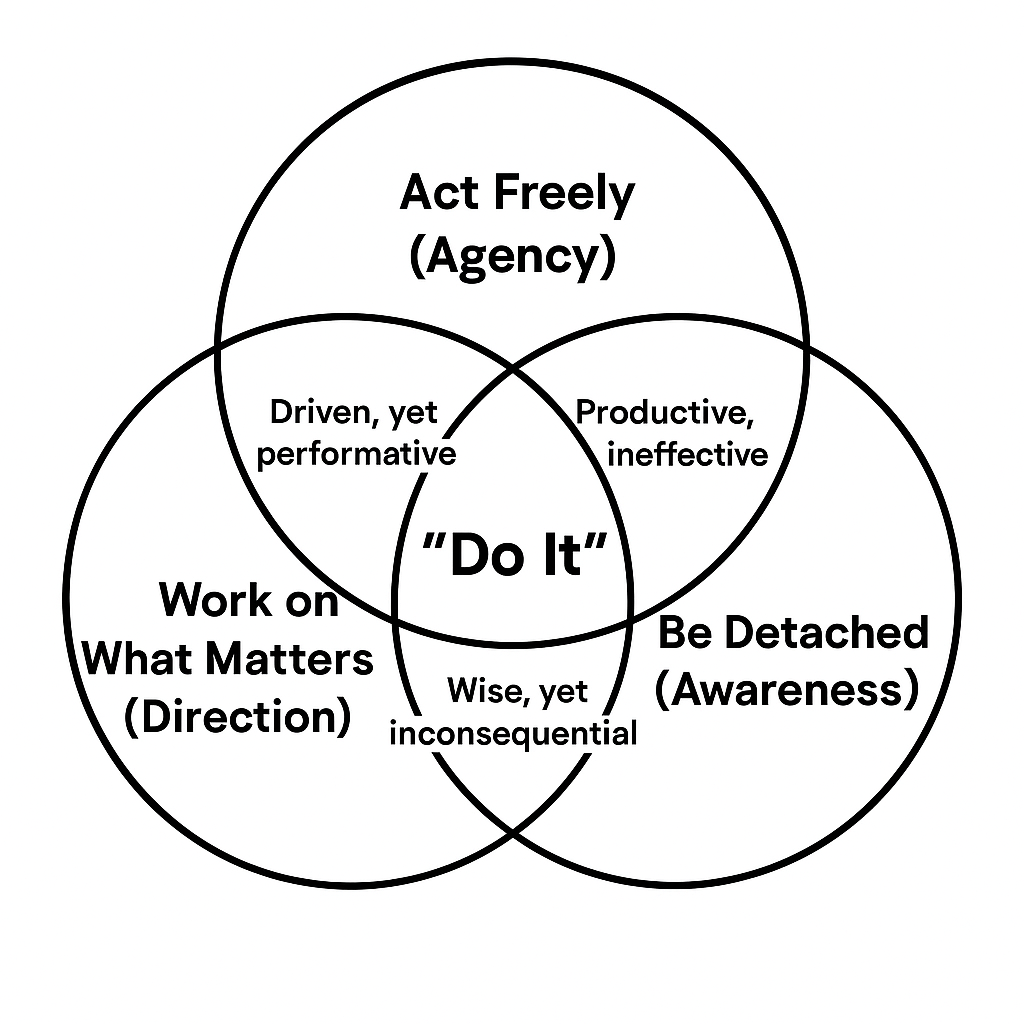
The three meanings of Do It answer three core questions:
- Where to start? Do it — Choose to act. Apply your agency.
- What to do? Do it — Work on problems that matter to you.
- How to do it? Do it — Take action from awareness, not attachment.
Each meaning is powerful on its own and can make us more effective if we regularly remind ourselves of them. But their real power comes from combining them.
When we act with agency and clear direction, we become driven and productive—but often entangled with ego. We chase outcomes and recognition, yet it never feels like enough.
If we act with agency and awareness but lack direction, our efforts are scattered. We're constantly busy, but rarely finish anything meaningful.
And if we have direction and awareness but fail to apply agency, we stay stuck in theory. Ideas stay in our heads. Projects never leave the notebook. Insight doesn't become impact.
True effectiveness comes from putting all three together.
Agency gets you moving.
Direction ensures it matters.
Awareness makes it sustainable and ego-free.
That's the power of Do It in full.